Where was Ahumada really standing when the shots were fired? Certainly not where the police artists say. Both the PDI and Carabineros had access, within the same investigation, to video footage of the scene showing that Ahumada was not next to the traffic light or the back of the pickup truck. If they reviewed that footage and still drew Ahumada in that position, the location was invented. If they didn't review it before issuing an expert report used to convict, that constitutes serious negligence for forensic experts. Neither alternative is acceptable.
1. Chile's Investigative Police (PDI)
Valparaíso Regional Forensic Science Laboratory — author of Expert Planimetric Report No. 478 (December 16, 2020), which places the victim and the defendant in a position and ballistic trajectory incompatible with the physics of projectile ricochet.
What she drew: Expert Planimetric Report No. 478 (Dec-16-2020) AHUMADA CASE
Diagram "Victim Luis Ahumada Villegas Position" / "Defendant Position" using the 1.60 m distance relied on to support the shot's trajectory.
Original document cover page — Chile's Investigative Police
2. Chile's Carabineros — LABOCAR
Carabineros Forensic Science Laboratory (LABOCAR), Valparaíso Prefecture — author of the forensic diagrams for the Ahumada and Molina cases. Both claim an upward 15° ricochet: in the Molina case, from a declared incidence of barely ~2°; in the Ahumada case, with no incidence angle stated at all. In neither case was the ricochet mark on the pavement ever found that should confirm the point of impact.
Carabineros de Chile
Mayor Ricardo Arriagada Sepúlveda
Oversight — LABOCAR, Valparaíso Prefecture
↓
Teniente Rodrigo Fedo Alvarado
Oversight — LABOCAR, Valparaíso Prefecture
↓
Teniente Juan Delgado Espinoza
Office Chief — LABOCAR Valparaíso
↓
Suboficial César A. Necul González
Forensic Crime-Scene Draftsman — LABOCAR
What he drew: LABOCAR diagram — Ahumada case (January 2, 2020) AHUMADA CASE
"Attempted Ballistic Trajectory" diagram with the position of the victim, the shooter, and the pickup truck plate HBGF-15.
Original document signature block — Carabineros de Chile / LABOCAR
Teniente Juan Delgado Espinoza
Responsible Draftsman — LABOCAR
What he drew: LABOCAR diagram — Molina case (January 2 and 9, 2020) MOLINA CASE
Diagram of Daniel Molina's vehicle and its radiator, the basis for the property-damage charge.
Original document signature block — Carabineros de Chile / LABOCAR
Capitán Jorge Guzmán Rojas
Investigating officer — Missing Persons and Vehicles Section, Carabineros Valparaíso
Not a ballistics expert. According to the expert analysis by Cristián Flores Morales (court expert in ballistics, weapons and explosives, No. 02-2024), Captain Guzmán personally inspected Daniel Molina's Hyundai and, using a rod and "different instruments" — not specialized ballistic equipment — measured the depth and angle of the hole in the plastic grille, projecting that angle to declare a bullet impact that would have ricocheted 1.53 m from the vehicle. That same 15° / 1.53 m figure is the one later adopted by the LABOCAR report MOLINA CASE.
Question for Prosecutor Paola Rojas: why was an officer with no ballistics certification — Captain Guzmán, from a vehicle-search section — allowed to determine and testify at trial to a "bullet impact" angle, instead of requiring an independent ballistics expert from the start? Was the Prosecutor afraid that a certified ballistics expert, examining the evidence independently, would take apart the case theory?
Where are the two pavement ricochet marks?
Neither was ever found — and neither was either bullet
Every claimed ricochet needs its own mark on the pavement: one for the shot that supposedly struck Molina's radiator, another for the one that supposedly struck Ahumada's thigh. The pavement at the scene is smooth concrete — a surface on which a real impact or ricochet would leave an easily identifiable mark, not a porous or irregular material that could hide one. Neither exists in the case file. Expert witness Osvaldo Faunes testified at trial that Carabineros had found a "mark in the pavement" — the supposed physical confirmation of Molina's ricochet — but that claim does not appear in any statement or LABOCAR document, and no Carabineros officer is on record as having found or measured it. The verdict dismissed this discrepancy with a simple "he was simply mistaken" (Faunes), without investigating who — if anyone — actually found it. For the Ahumada case it's worse still: there is no record anyone even looked for a ricochet mark. This question is part of the investigation currently underway (RIT O-7926-2025, RUC 2510047915-2, "COBIN/NN"), ordered by Valparaíso Chief Prosecutor Elizardo Tapia Pinilla and carried out by the PDI's BICRIM Curauma unit (Detective Cristián Severino).
And neither bullet ever turned up either. No projectile was recovered from Molina's gearbox or radiator, from Ahumada's thigh, or anywhere else at the scene. Two claimed ricochets, zero ricochet marks found, zero bullets recovered.
According to John Cobin: Molina's ricochet mark doesn't exist because he never fired at his vehicle — he fired standing, outside the vehicle, toward the corner of Las Brisas street, and those two shots hit the ground.
The defense's theory on Molina's damage: according to John Cobin, the radiator damage was likely self-inflicted opportunistically, possibly with a crowbar. Molina kept his vehicle for more than two months before reporting the damage — only after Captain Jorge Guzmán Rojas (Vehicle Search Section) declared it a "bullet impact" — with no chain of custody for the vehicle during that period. Furthermore, the entry hole is irregular, roughly 25 mm tall by 19 mm wide — dimensions and shape incompatible with a .40-caliber (10.6 mm) projectile, which should produce a smooth, round hole, not an irregular gash.
3. Carabineros Hides the Protocols — Twice
On two occasions, two years apart, Carabineros de Chile has denied access to the ballistic-trajectory protocol that its own LABOCAR laboratory used to produce the evidence cited in Sections 1 and 2. The PDI has not been asked about this point.
Coronel Loreto Osses Coloma
Head, Dept. of Public Information and Lobbying, Office of the General Subcomptroller — Carabineros de Chile
Denied: a request for a copy of the "Ballistic Trajectory Protocol used by LABOCAR... in effect in 2019," filed by attorney Loreto Letelier Barrera — then John Cobin's attorney (2023–2024) — (Portal No. AD009W0071640).
Resolution: Exempt Resolution (E), Santiago, April 30, 2024.
Grounds cited: art. 21 No. 1(a) of Law 20.285 (affects the proper performance of the agency's functions) and art. 21 No. 3 (affects national security, particularly national defense, public order, or public safety).
Coronel Iván C. Bustamante Cerda
Head, Dept. of Public Information and Lobbying, Office of the General Subcomptroller — Carabineros de Chile
Denied: John Cobin's request (Jul-11-2026, Portal No. AD009W0087896) for LABOCAR's protocols, manuals and instructions on evidence collection, chain of custody, goniometers, and projectile trajectories/ricochets in effect in November 2019.
Resolution: Exempt Resolution No. 139, Santiago, August 10, 2026.
Grounds cited: secrecy of investigative proceedings (art. 182 Criminal Procedure Code) and art. 21 No. 1(a) of Law 20.285 (affects the proper performance of the agency's functions).
Both resolutions invoke, in their own text, Supreme Court case law (Docket No. 6663-2012 and Docket No. 21.377-2015) requiring that secrecy be justified in detailed, specific terms — a generic invocation is not enough. Neither resolution meets that standard for technical protocols from 2019, now more than six years old.
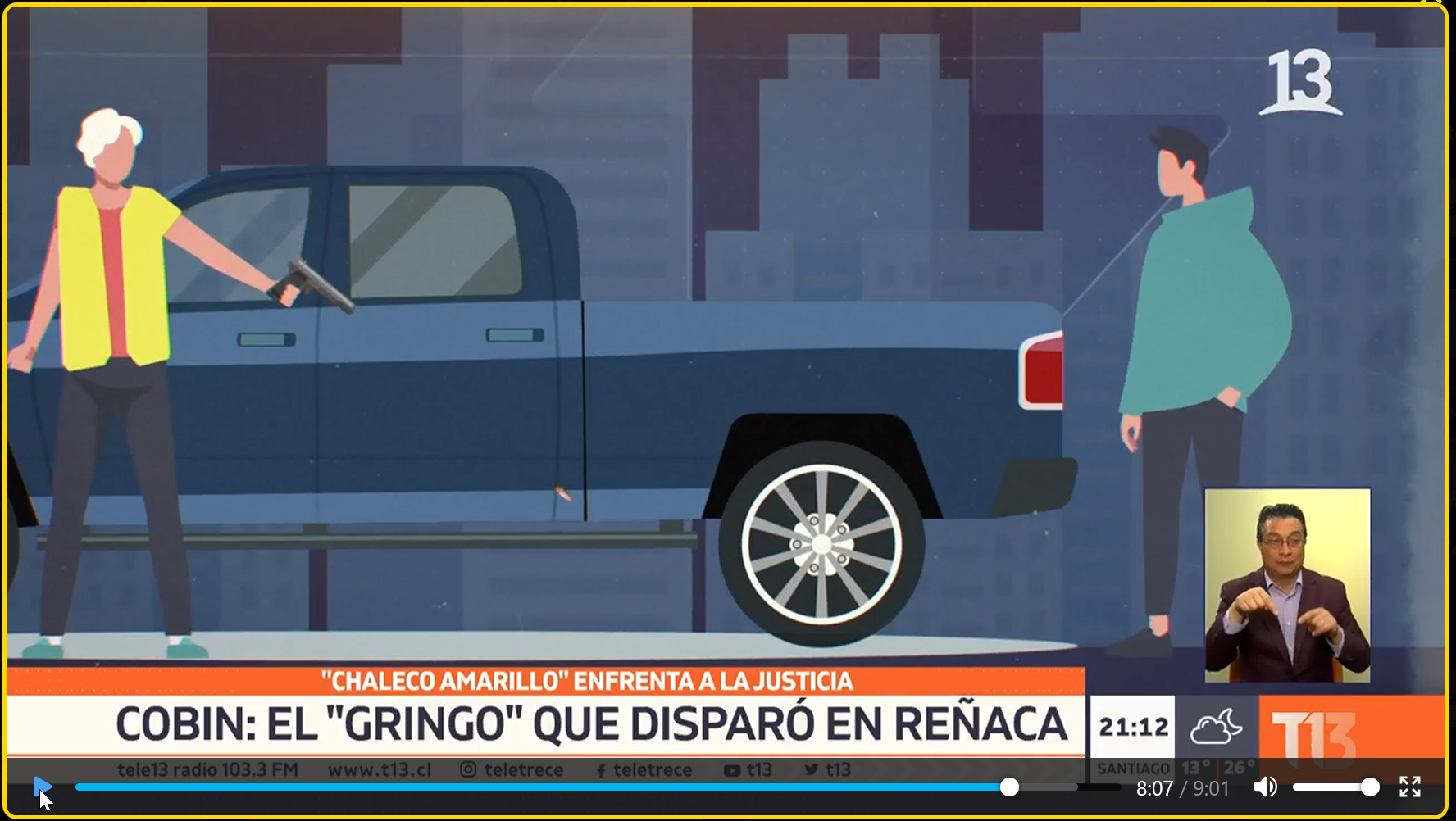
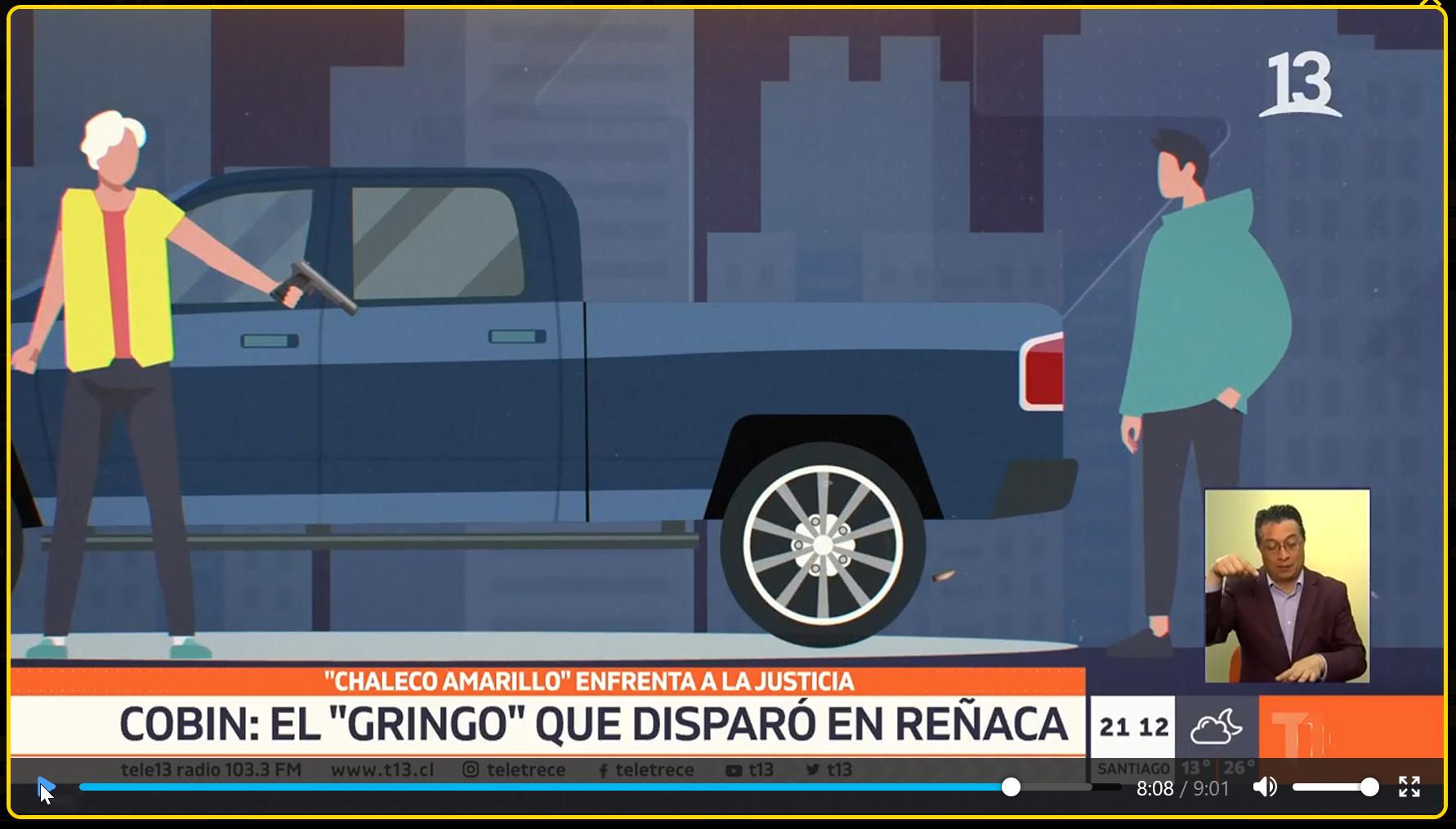
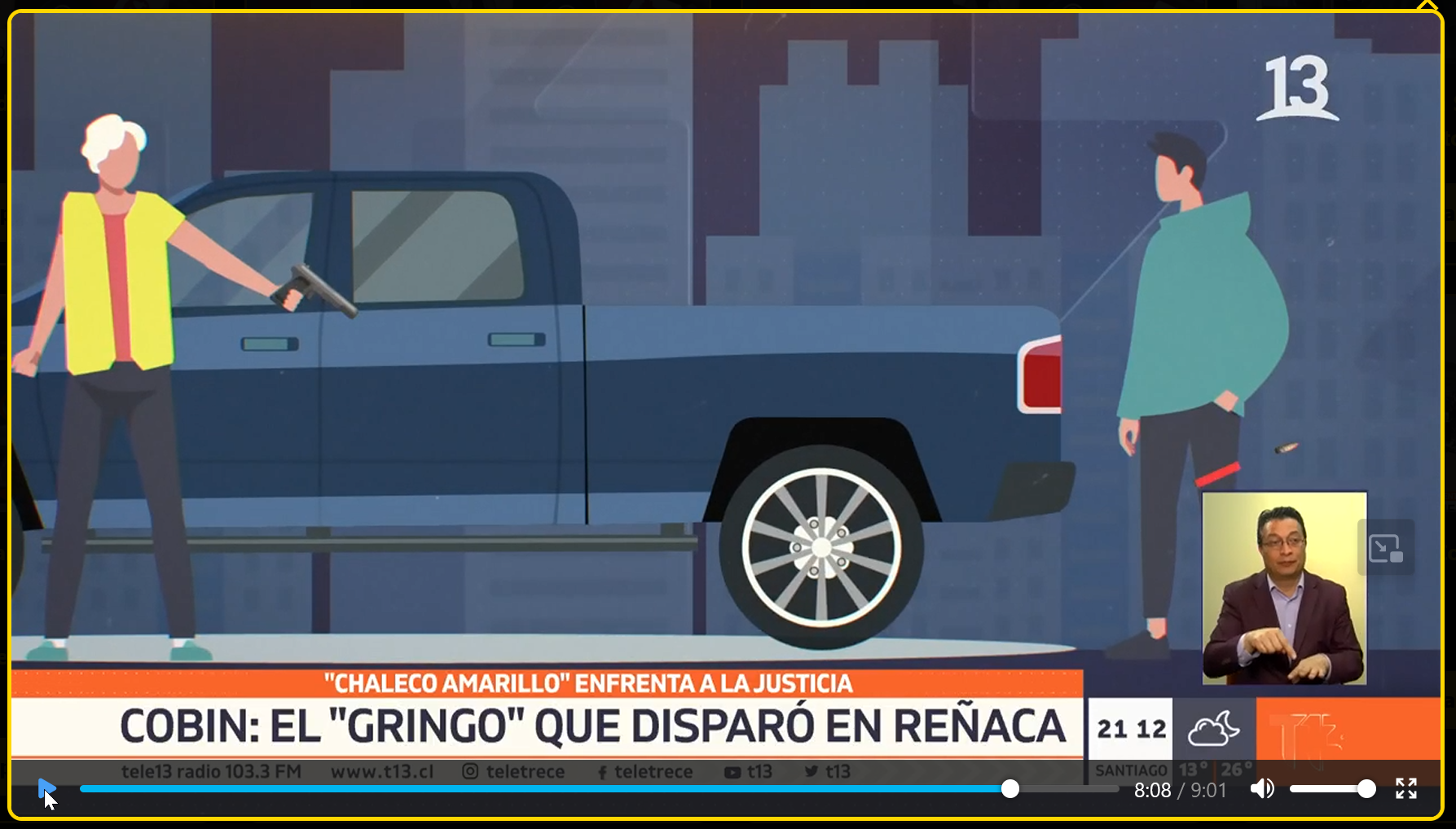
Even a national TV channel illustrated the ricochet theory with a cartoon — a graphic recreation, not a real record of events.
Tele 13 — the reporter's cartoon
In its report on the case, Tele 13 showed a cartoon illustrating a bullet ricochet "far away, going through the thigh" of Ahumada. This video is published in the Video Evidence section of the case page. The full sequence, minute 8:07–8:08:
1. The shot (8:07)
2. Ricochet in the air (8:08)
3. Through the thigh (8:08)
Comparison: cartoon physics
The trajectory described in the LABOCAR and PDI reports on the Ahumada case — an upward 15° ricochet, with no incidence angle ever stated that would have produced it — resembles cartoon physics more than the laws of reflection. It's the same kind of physics that lets a bullet chase a character through the air and catch him from behind, like in the classic cartoons of Tom and Jerry, Elmer Fudd, or the Coyote — fun on screen, impossible in reality. And it's not just the Ahumada case: the same 15° ricochet reappears in the Molina case, at a completely different distance — there, at least, with a declared incidence of barely ~1°–2°, just as impossible. Two victims, two scenes, the same recycled exit angle, and no ricochet mark confirming it in either one.
Molina (radiator, 52.3 m): the same 15° ricochet, and the same violation of physics. The report attributes the damage to Molina's radiator to a ricochet rising ~15° from an incidence of barely ~1°–2°, fired from 52.3 m. That breaks two laws at once: the law of reflection, which for an elastic bounce requires exit angle = entry angle; and conservation of energy, which forbids the exit angle from being greater than the entry angle — a real ricochet loses energy and comes out flatter, never steeper. Going from ~2° to 15° is a 7-to-15-fold jump, as if the bullet had gained energy on hitting the pavement.
At a 15° climb, the bullet rises more than 1.3 meters within the first 5 meters of flight — far above a radiator, which sits nearly at ground level — long before covering a fraction of the reported 52.3 m. A ricochet actually consistent with the declared incidence (~1°–2°, as physics requires) would rise only ~0.9–1.8 m over the full 52.3 m: geometrically possible, yes, but not the angle LABOCAR and Captain Guzmán Rojas declared. They needed the 15° for the story to work, not because physics backed it up.
Ahumada (thigh, 1.62 m / 3.43 m): the geometry demands an even more impossible angle — and explains why there was never a ricochet mark. Ahumada was 1.62 m from Cobin according to the PDI, or 3.43 m according to LABOCAR. Cobin was seated in the cab, with the muzzle about 1 m off the ground; the wound is at 72 cm height. If the bullet touched the pavement at some midpoint and rose again — as the ricochet theory requires — the law of reflection requires the downward and upward angles to be equal. Solving the geometry under that condition (connecting the muzzle height to the wound height within each reported distance), the required angle is ~46.7° (PDI distance) or ~26.6° (LABOCAR distance). For the Ahumada case, LABOCAR and PDI never state what incidence angle would have produced that 15° ricochet — the figure simply doesn't exist in the case file, any more than the pavement ricochet mark does. But even using as a reference the only incidence angle that appears anywhere in the whole case — the ~1°–2° declared for Molina's radiator, at 52.3 m — the difference is 13 to 47 times over. And a 46.7° ricochet falls squarely in the 45°–90° range in which, as the high-speed video below shows, the projectile is destroyed or fragments on impact — it doesn't stay intact to pass through a thigh at 72 cm height.
No ricochet is even needed to explain the wound: a simple straight line from the muzzle (~1 m) to the thigh (72 cm), never touching the ground, requires only ~9.8° of decline at 1.62 m, or ~4.7° at 3.43 m — an ordinary, direct shot. The absence of a ricochet mark in both scenes isn't an investigative oversight: it's the absence of physical evidence for a ricochet that, by the case's own physics, would have had to be far more violent than LABOCAR and PDI are willing to admit.
Try any firing angle: none of them solve the problem. Cobin seated, muzzle ~1 m off the ground. If he fires at 26.6° — the angle that does connect the LABOCAR distance of 3.43 m to the thigh — at the PDI distance of 1.62 m the bullet is still ~19 cm off the ground: ankle or shoe height, not thigh height. To then still reach 72 cm would require a second, nearly vertical ricochet, of about ~85°–90°, on the final stretch — something no ballistic ricochet produces.
If he instead fires at 60°, pavement impact occurs just ~0.58 m from Cobin, leaving ~2.85 m (LABOCAR) or ~1.04 m (PDI) to Ahumada. There, geometrically, an exit angle under 60° — ~14° or ~35° — would in fact reach the thigh, satisfying the law of reflection (exit ≤ entry). But a 60° incidence falls squarely in the 45°–90° range in which, as the high-speed video below shows, the projectile is destroyed or fragments on impact — unless it were a stainless-steel bullet, not the conventional ammunition in this case.
And there's an additional problem, independent of whichever ricochet angle is chosen: the case file itself describes the thigh wound channel as sloping upward at barely ~12°. A bullet arriving at the nearly vertical trajectory (~85°–90°) of the first scenario would have to turn in mid-flight to the ~12° of the wound channel before entering the tissue — and a projectile has no wings or engine to make that turn.
The real physics: high-speed video
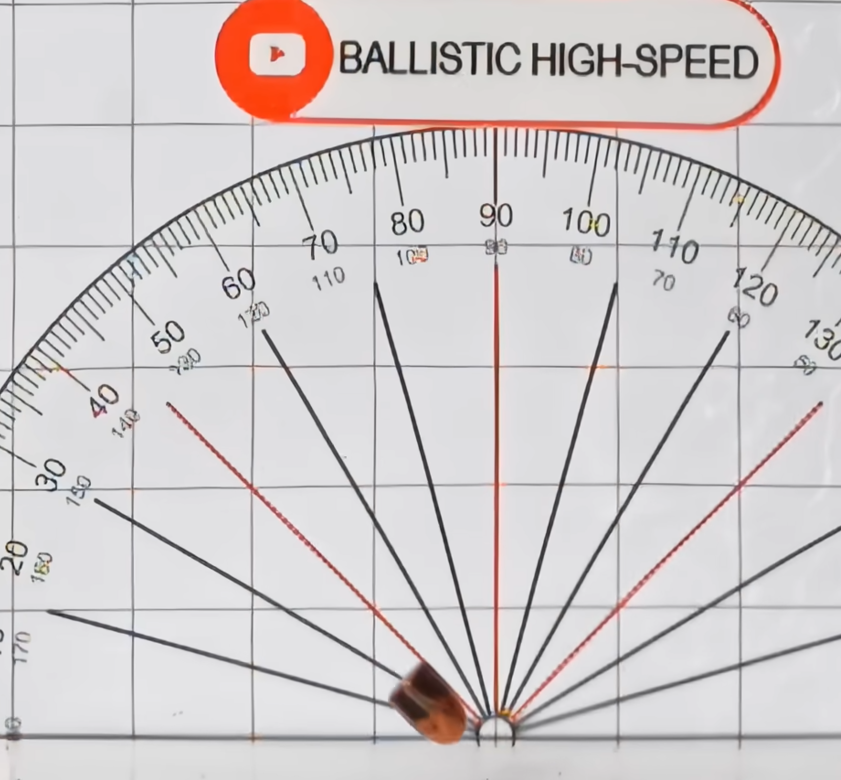
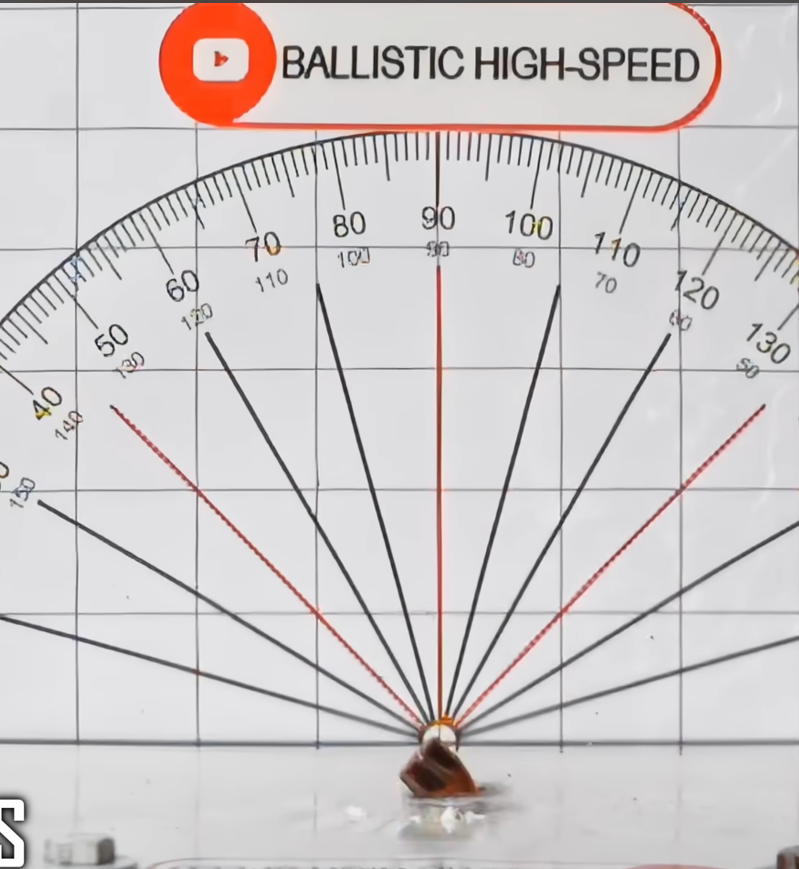
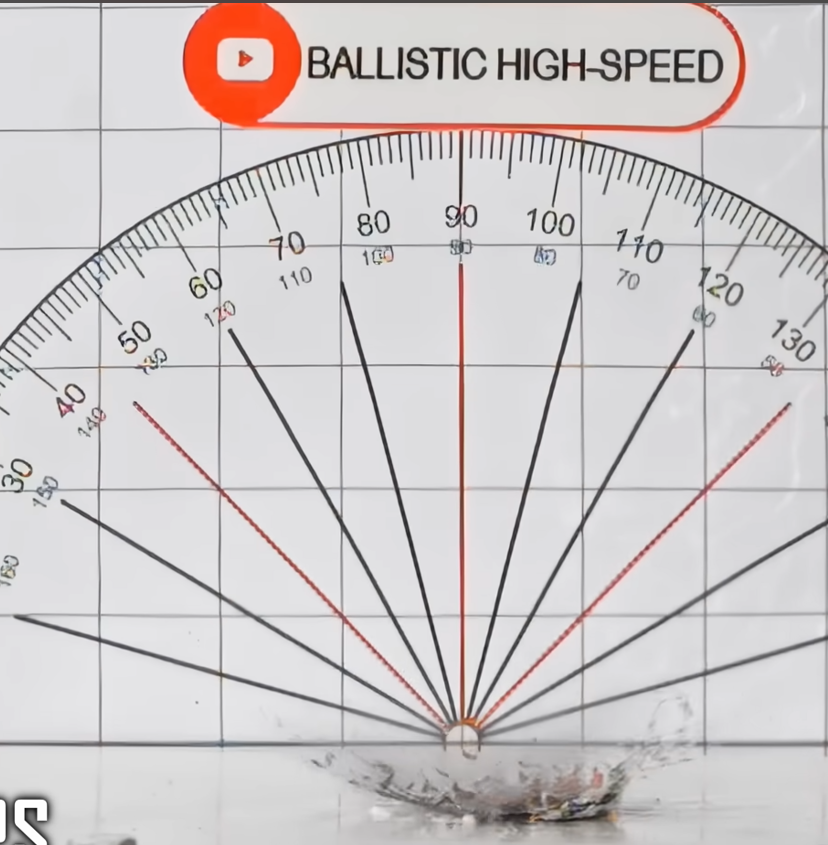
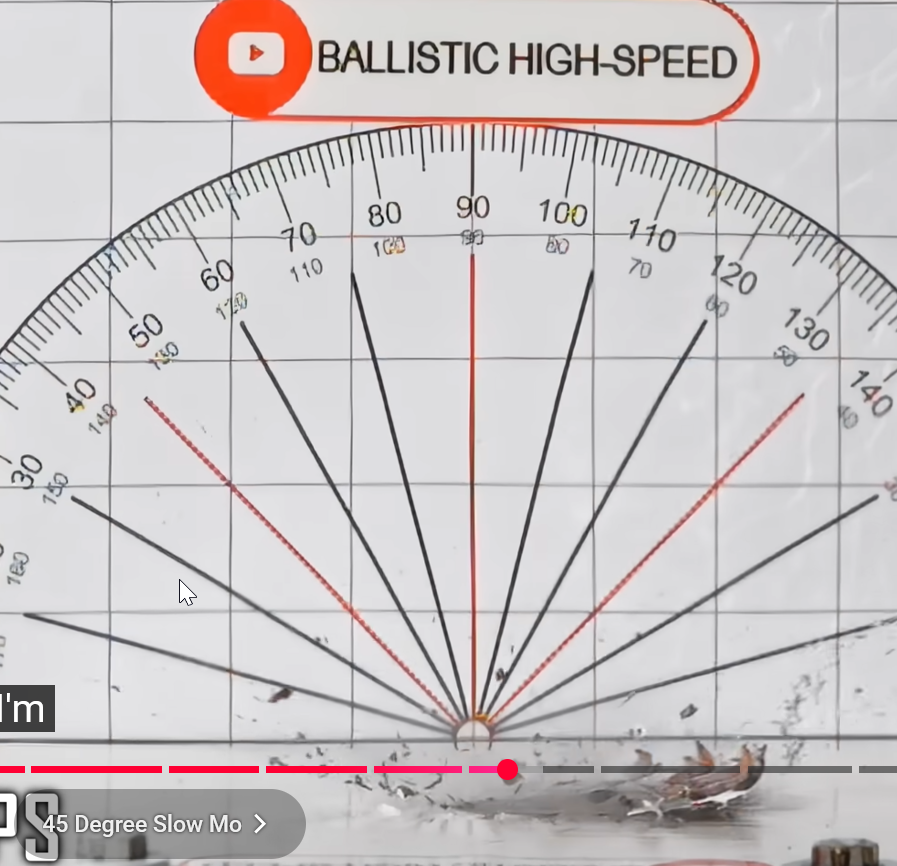
Projectiles that strike a hard surface at incidence angles above 30° — and especially between 45° and 90° — are destroyed or fragment, rather than ricocheting cleanly as LABOCAR and PDI claim. The following sequence (45°, high-speed camera) shows the impact and progressive destruction of the projectile:
1. Impact
2. Fragmentation
3. More fragmentation
4. Total destruction
The video begins around the 7:20 mark, where this sequence can be seen:
LABOCAR diagram, Carabineros de Chile, January 2, 2020, Annex No. 2 of 12 (César Necul González; Office Chief: Juan Delgado Espinoza).
LABOCAR diagram, Carabineros de Chile, January 2 and 9, 2020 — Molina case (Juan Delgado Espinoza).
Exempt Resolution (E), Carabineros de Chile, April 30, 2024 (Colonel Loreto Osses Coloma).
Exempt Resolution No. 139, Carabineros de Chile, August 10, 2026 (Colonel Iván C. Bustamante Cerda).
Expert Report No. 02-2024, Cristian R. Flores Morales, Court Expert in Ballistics, Weapons and Explosives — Molina case, radiator (requested by attorney Loreto Letelier Barrera). View document · View on the case page
Expert Report No. 03-2024, Cristian R. Flores Morales, Court Expert in Ballistics, Weapons and Explosives — Ahumada case, thigh (requested by attorney Loreto Letelier Barrera). View document · View on the case page
Criminal complaint for falsification of a public instrument (art. 193 No. 4 and No. 6 Penal Code), filed July 12, 2026.
Complete documents available on the case page: policyofliberty.com/criminal-case.php