 |
Policy of liberty is dedicated to the advancement of liberty and responsibility in society. Its philosophy is pro-life libertarian (rather than neo-conservative) on economic issues, adhering to biblical norms for proper social perspective but rarely looking to the state for solutions to social problems. POL provides resources, links, books and articles, an email list, photos and links to famous economists, great quotations for liberty. |
 |
Book Description: |
Title |
Format |
ISBN |
Publisher and Year |
Pages |
Price |
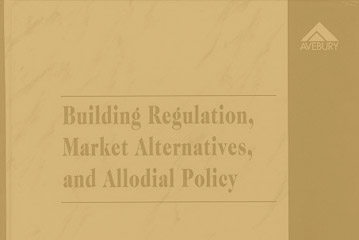
Building Regulation, Market Alternatives, and Allodial Policy 347.3'0644Library of Congress Catalog Card Number 96-79120 |
PDF E-Book |
0-9725418-4-5 |
Alertness Books 2003 |
248 |
$3.95 |
Click here to BUY the PDF E-BOOK version direct from Alertness Books.
Summary: |
|
This book provides evidence (via two case studies) of government's failure (USA) to regulate building safety and quality, at least insofar as the public interest is concerned. Market regulatory alternatives are suggested that could conceivably replace government regulation. In addition, allodial policy is suggested as an alternative to replace current real property policy. 248 pages. Amazon Interview with Dr. Cobin This book demonstrates that government regulation of building safety and quality does not always improve either safety or quality. Dr. Cobin suggests that market alternatives, which work well in other sectors, like the purely market regulated rare coin industry, could be used instead to improve effectiveness and efficiency. Moreover, allodial real property policy would be a viable alternative for alleviating many of the problems that might have led to government failure, including public choice and knowledge problems. This book will be of interest to academics and people in the architecture and building industry, or in urban planning. |
Contents
Introduction
1 A case study on building
fire safety (Baltimore)
2 A case study on building quality
(mostly rural counties in West Virginia and Pennsylvania)
3
Market-regulatory alternatives (rare coin and gemstone industries)
4
A policy overview of American allodialism
5 Concluding
implications for public policy
App. A Shepardizing results of
important cases
App. B Chronological important case citations
with topics
Foreword
by Walter E. Williams, Ph.D.
Chairman, Economics Department,
George Mason University
In
contemporary society, people increasingly rely on government to
provide many goods and services. Those who champion government
allocation of resources fail to consider both the effectiveness of
government allocation and the moral questions involved. In the last
century, resistance to government intervention, from paper money to
economics regulation, was far more pervasive and effective than it is
today. Indeed, today's Americans only have a faint understanding of
the Constitution and its envisioned restraints on government
activity. The Constitution and its philosophical underpinning are
rarely taught and understood by most Americans. That is a remarkable
change from the time of our nation's founding when a large percentage
of Americans were conversant with the ideas of Locke, Cato, Paine and
the Federalist Papers.
The Declaration of Independence, one
of America's most important political documents, contains statements
that are today greeted with hostility, or at best, viewed as
extremist. The motif of America's inauguration has become too radical
to discuss without extreme qualification, and those who want to use
it to assail the present political process are labeled 'radicals.' Of
course, the liberty-loving American founders also carried this
sobriquet. Another characteristic of the modern age is that Americans
have become carelessly oblivious to the historical struggle for the
vast liberties they enjoy but the preservation of which they now seem
to disregard.
Dr. Cobin's book is part of the growing
literature of case studies legal-philosophical treatises that provide
economic analyses of public policy. While many other studies about
regulation have been produced, Dr. Cobin has provided a major
contribution to local regulatory issues. Building regulation and the
modern system of private property rights are areas which are taken
for granted by most people. However, this book reveals that there are
more than trivial policy defects in our system of private property
rights. Dr. Cobin has established that there is a real need to
re-examine how private property rights are regulated. In the same way
that public choice theory has exploded the notion of altruistic
bureaucrats and politicians, who serve the interest of the public to
the disregard their private interests, Dr. Cobin's book unmasks local
building regulations whose ostensible purposes are to serve the
public interest.
The results of Dr. Cobin's work lead us into
a new dimension of public policy deliberation, i.e., whether
government regulations produce more or less safety than that provided
through the market 'regulation.' If government regulations reduce the
safety and quality of goods or services, then it is in the public
interest to revise or eliminate such regulation. Dr. Cobin has also
done a commendable job of demonstrating that market provision can
produce efficient and effective regulation, even for informational
services that are assumed to be public goods. After demonstrating the
failings of government regulation and provision of information about
quality, Dr. Cobin shows us that markets can do in building and
safety regulations what it has done the rare coin and gemstone
industries.
Dr. Cobin's work goes even further. In addition
to suggesting an adequate policy alternative for a failing system of
building regulation, he also resurrects an alternate legal philosophy
of real property. This system, known as 'allodialism,' is not a novel
concept but has deep roots in Western civilization. However, it has
been obfuscated over the years in favor of feudalism. It may surprise
many readers that the American system of real property, not to
mention the rest of the world's is essentially feudalistic. This fact
should be repugnant in America where the Founding Fathers sought to
abrogate all fetters of tyranny and oppression. An allodial real
property system would make private property rights absolute and not
subject to any form of coercive taxation or regulation. Subsequently,
allodialism would serve to secure rights to property as guaranteed by
the Bill of Rights and the Declaration of Independence.
Hopefully,
this study will provide the impetus for scholarship, in both case
studies of local regulation and renewed discussion and analysis of
allodial property rights. Not only can this book be added to the
annals of regulatory studies which support market over government
provision, but its philosophical basis can be used in basic
disciplines, including law, economics, philosophy, political science
and history. Dr. Cobin has made an important contribution to an
important public policy area in a novel and frequently overlooked
way.

|
|||

|

|

|

|
|
|
|||
| home | free market textbook | public policy books | articles & papers | links | quotes | contact | about me | |||
Dr. John M. Cobin
José Suárez 185, Depto. 2, Viña del Mar, Chile 2541311
Phone/WhatsApp/Telegram: +56-949900391
Email: osorno7@earthlink.net | dinamico900@gmail.com
Website: www.policyofliberty.com
© 2026 Policy of Liberty. All rights reserved. | Non-fiction Writing, Editorial Services & Policy Analysis